
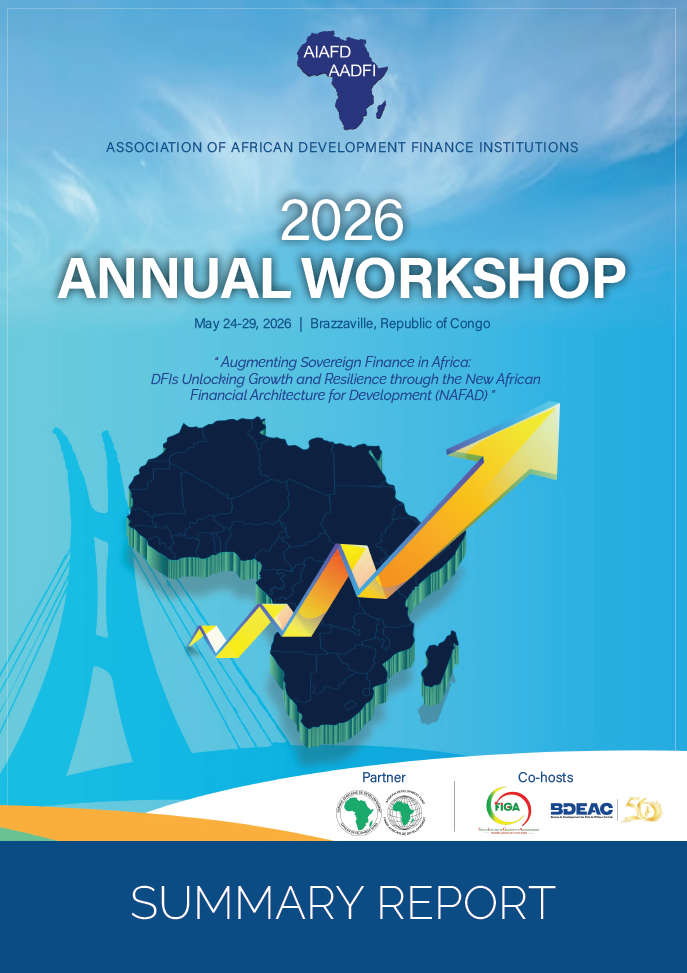
Summary Report of the 2026 Annual Workshop
 12 de August de 2026
This report summarizes the key discussions, conclusions and recommendations of the 2026 Annual Workshop of the Association of African Development Finance Institutions (AADFI), held in Brazzaville, Republic of Congo. Under the theme “Augmenting Sovereign Finance in Africa: DFIs Unlocking Growth and Resilience through the New African Financial Architecture for Development (NAFAD),” the workshop examined how African development finance institutions can strengthen capital mobilization, reduce financing costs, expand risk-sharing mechanisms and accelerate the preparation of bankable projects.
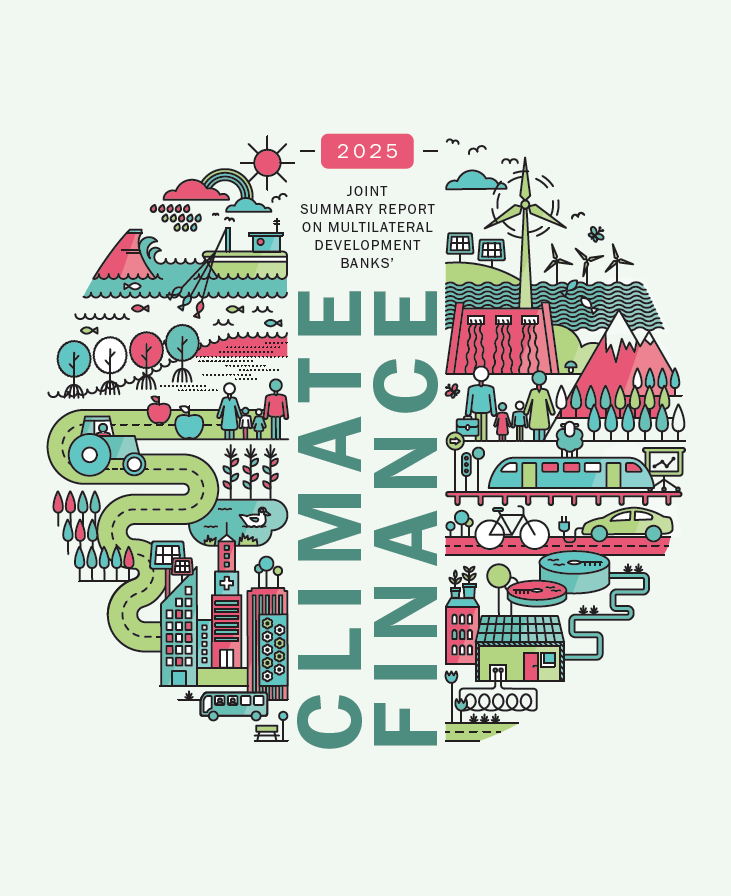
2025 Joint Summary Report on Multilateral Development Banks’ Climate Finance
Climate / Resilience Development Finance Investments MDBs Paris Agreement Private Sector Publications Sustainability
4 de August de 2026
This joint report provides a consolidated overview of climate finance committed by major multilateral development banks in 2025. It presents key figures on mitigation and adaptation finance, regional distribution, financial instruments, co-financing and private capital mobilisation across low-, middle- and high-income economies.
African Development Finance Institutions Performance Survey 2025
4 de June de 2026
The African Development Finance Institutions (DFIs) Performance Survey 2025 presents the results of a survey covering 37 African DFIs, assessing their financial performance, operational effectiveness, institutional characteristics, and development impact during fiscal year 2024. The report provides empirical evidence on how African DFIs balance financial sustainability with their development mandates, highlighting trends in governance, lending models, sectoral priorities, climate finance, gender inclusion, financial performance, and institutional capacity. It also identifies key challenges related to capitalization, risk management, and operational effectiveness, offering policy recommendations to strengthen the resilience and development impact of African DFIs.
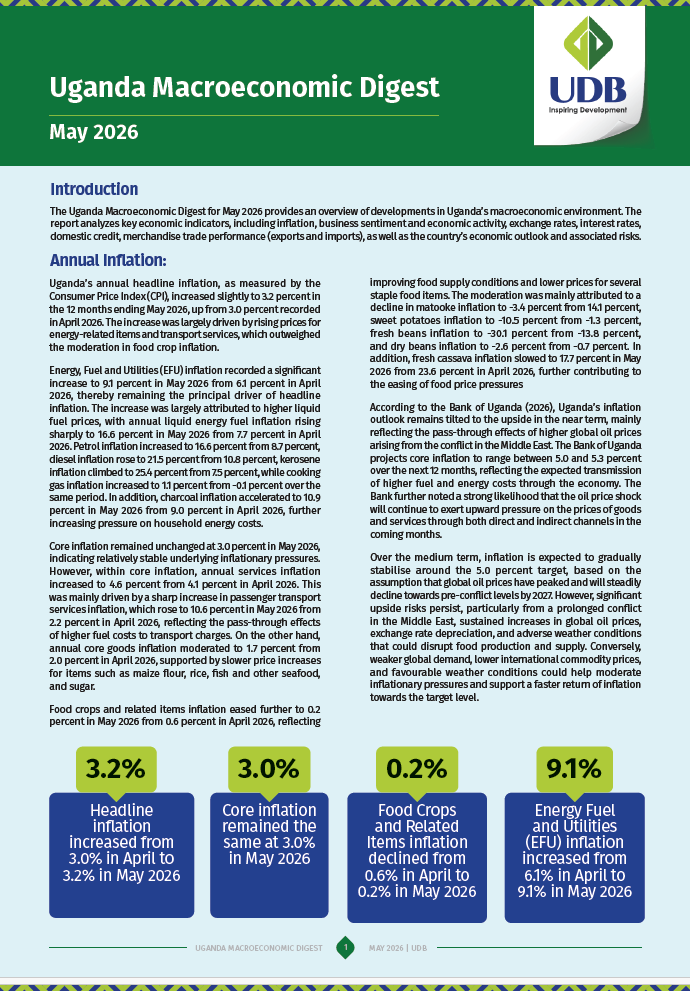
Uganda Macroeconomic Digest – May 2026
Development Economic Development / Stability Economy Finance Foreign Trade Public banks Publications Risk
30 de May de 2026
The Uganda Macroeconomic Digest for May 2026 provides an overview of recent developments in Uganda’s macroeconomic environment. It examines inflation, business sentiment and economic activity, exchange rate movements, interest rates, domestic credit, merchandise trade, and the country’s economic outlook and associated risks.
Financing for Sustainable Development Report 2026
13 de May de 2026
The Financing for Sustainable Development Report 2026: Implementing the Sevilla Commitment finds that development progress is imperiled by global fragmentation and a financing squeeze facing developing countries. Instead of progress promised in 2015, the world is rapidly moving backward. The FSDR 2026 shows how the Sevilla Commitment can be operationalized to reverse the current trends in financing for development, even in these most difficult circumstances. The implementation of the Sevilla Commitment represents the best hope to achieve the SDGs.