
Principles for Taxonomy Interoperability
The Principles for Taxonomy Interoperability, launched by the Taxonomy Roadmap Initiative at a Pre-COP30 event in São Paulo, guide policymakers in developing sustainable finance taxonomies that are credible and comparable across borders. As over 50 taxonomies exist globally, interoperability is essential to facilitate cross-border investment and efficient capital allocation. The Principles provide common tenets for taxonomy design, governance, and implementation, enabling greater transparency and investor confidence. By fostering alignment between emerging and developed markets, interoperable taxonomies can mobilize the climate finance needed to achieve decarbonization, resilience, and the Paris Agreement goals.
Summary Report of the 2025 Annual Workshop
The 2025 Annual Workshop of the Association of African Development Finance Institutions (AADFI), held in Abidjan, Côte d’Ivoire, celebrated AADFI’s 50th Anniversary under the theme “Joining Forces for a More Sustainable and Greener Future for African DFIs.” Hosted by BNI, CDC-CI, and SGPME, and supported by the African Development Bank (AfDB), the event gathered over 250 participants from 36 countries, including senior representatives of DFIs, MDBs, and central banks. Discussions focused on scaling up sustainable investments, innovative financing, and partnerships for climate action. The opening ceremony featured addresses from the AfDB and the Ivorian Ministry of Economy and Finance, reaffirming DFIs’ strategic role in advancing Africa’s sustainable development agenda.
Sustainability Proofing under InvestEU: Considerations and Simplification Proposals
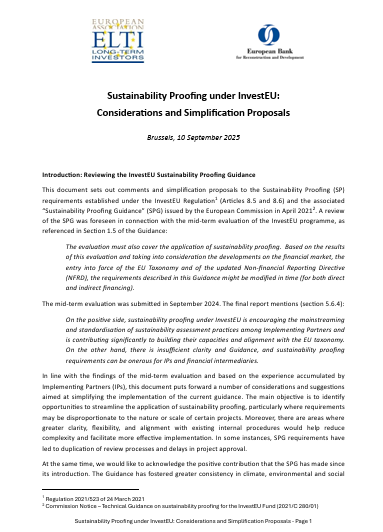
This position paper evaluates the InvestEU Sustainability Proofing Guidance after the 2024 mid-term review, incorporating Implementing Partners’ experience. It recognizes progress in harmonizing sustainability standards but highlights disproportionate administrative burdens. The authors propose limiting proofing to material subprojects or corporate level, delegating legal compliance to institutional processes, and raising financial thresholds to EUR 50 million. Other recommendations include increasing the carbon footprint threshold to 100,000 tCO2e per year, providing a non-binding list of adaptation data sources, simplifying the social dimension in robust legal contexts, relying on professional judgment for economic analysis, and removing the annual sustainability report requirement. The paper calls for a constructive technical dialogue with the European Commission.
Sevilla Commitment: Fourth International Conference on Financing for Development

The Seville Commitment highlights the transformative role of development banks and multilateral organizations in addressing today’s global challenges. Adopted as a guiding framework, it emphasizes the importance of sustainable development, social inclusion, and climate resilience. The document calls on financial institutions to move beyond traditional roles and actively promote innovation, cooperation, and systemic change. By fostering stronger partnerships and mobilizing resources, the Seville Commitment establishes a clear path toward more sustainable and equitable development.
European Public Investment Outlook (EPIO)

Investing in the Structural Transformation: 2024 European Public Investment Outlook highlights the urgent need for strategic, well-coordinated public investment in the EU. It emphasizes industrial policy focused on sustainability, innovation, and resilience. Featuring country analyses and thematic insights, the volume calls for stronger EU integration, long-term planning, and public-private collaboration to address climate change, technological gaps, and global competitiveness challenges.
Powering innovation: future- proofing DFIS for Sustainable Development

This special issue of DevTalk Magazine highlights the 48th ADFIAP Annual Meetings in Muscat, Oman, focusing on innovation, sustainability, and digital transformation in development finance. It showcases ADFIAPNET, award-winning initiatives, and thought leadership from member institutions. The publication emphasizes how DFIs are driving inclusive growth, supporting green finance, and adapting to future challenges across Asia and the Pacific.
2024 África, Informe De Desarrollo Sustentable

El 2024 África, Informe de Desarrollo Sustentable (ASDR) revisa el estado de la implementación de los dos programas en África y ofrece recomendaciones de política para facilitar su consecución. Como en años anteriores, el 2024 informe se alinea con el tema y los correspondientes Objetivos de Desarrollo Sostenible (Ods) de el foro político de alto nivel sobre el desarrollo sostenible (HLPF) seleccionados para cualquier año en particular.
Documento de Posición común sobre el Futuro de la Política de Cohesión con un Enfoque en Garantizar la Flexibilidad Regional y Promover la Simplificación

Este documento presenta las perspectivas y preocupaciones de las asociaciones y redes sobre el futuro de la Política de Cohesión en Europa. Se destaca la política de importancia en el fomento del desarrollo regional y apoyo a la verde y digital de las transiciones. Además, se pone de relieve el importante papel desempeñado por sus miembros en la aplicación de la Política de Cohesión, aprovechando su fuerte presencia en las economías locales.
ADFI Informe resumido del Taller Anual de 2024

The 2024 Annual Workshop of the Association of African Development Finance Institutions (AADFI) was held on the theme “A practical road map for African DFIs in accessing green funds” on May 27, 2024,
The workshop’s main objectives were to enhance African development finance institutions’ role in mobilizing green finance, update and expand their knowledge and operational methods for accessing green funds, and encourage peer learning and experience sharing.
Financiación verde como una palanca para la entrega sostenible de los sistemas agroalimentarios – Un panorama global de estudio

Financiación verde es una crítica desencadenante de esta palanca con el fin de satisfacer en todo el mundo, comprometido inversiones en el logro de los objetivos de desarrollo sostenible, y es uno de los más importantes instrumentos para la promoción sostenible y resiliente al clima de los sistemas alimentarios. La provisión de beneficios ambientales a través de la gobernanza social es una función de alto potencial, verde servicios financieros pueden desempeñar.