
African Development Finance Institutions Performance Survey 2025
The African Development Finance Institutions (DFIs) Performance Survey 2025 presents the results of a survey covering 37 African DFIs, assessing their financial performance, operational effectiveness, institutional characteristics, and development impact during fiscal year 2024. The report provides empirical evidence on how African DFIs balance financial sustainability with their development mandates, highlighting trends in governance, lending models, sectoral priorities, climate finance, gender inclusion, financial performance, and institutional capacity. It also identifies key challenges related to capitalization, risk management, and operational effectiveness, offering policy recommendations to strengthen the resilience and development impact of African DFIs.
Financing for Sustainable Development Report 2026
The Financing for Sustainable Development Report 2026: Implementing the Sevilla Commitment finds that development progress is imperiled by global fragmentation and a financing squeeze facing developing countries. Instead of progress promised in 2015, the world is rapidly moving backward. The FSDR 2026 shows how the Sevilla Commitment can be operationalized to reverse the current trends in financing for development, even in these most difficult circumstances. The implementation of the Sevilla Commitment represents the best hope to achieve the SDGs.
Guideline Handbook for Strengthening African DFIs for Climate-Resilient Development
The Guideline Handbook for Strengthening African DFIs for Climate-Resilient Development provides a practical framework to help African development finance institutions (DFIs) enhance their capacity to mobilize and deploy climate finance. It examines the evolution, mandates, and institutional challenges of African DFIs and presents actionable guidance on governance, financial readiness, project preparation, ESG integration, human capital, digital monitoring systems, and investment readiness. Through case studies and practical tools, the handbook identifies best practices for strengthening institutional resilience, improving access to concessional and blended finance, and aligning operations with national climate priorities, the Paris Agreement, and the Sustainable Development Goals (SDGs).
ADFIAP-AADFI JOINT INTERNATIONAL CEO FORUM 2025
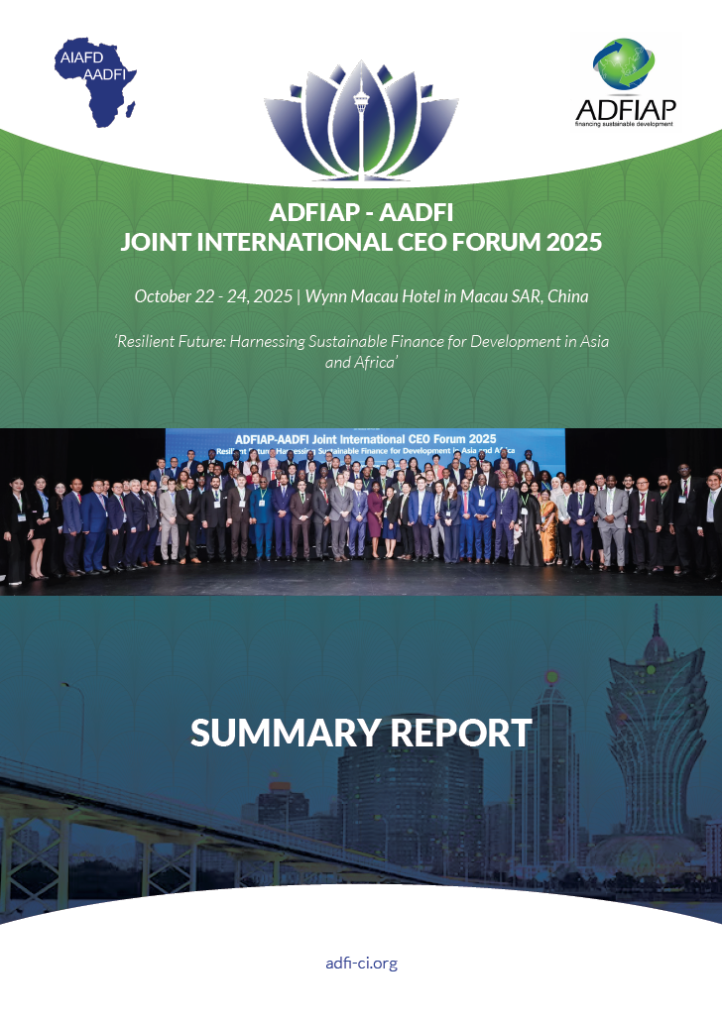
The ADFIAP–AADFI Joint International CEO Forum 2025 Summary Report presents the main discussions and outcomes of a high-level forum that convened development finance leaders from Asia, the Pacific, and Africa under the theme “Resilient Future: Harnessing Sustainable Finance for Development.” The report highlights strategic recommendations on sustainable finance, climate resilience, blended finance, digital transformation, governance, regulatory frameworks, and private sector mobilization. It emphasizes the central role of national development banks and development finance institutions (DFIs) in advancing inclusive, climate-resilient growth through stronger partnerships, innovative financing mechanisms, and improved institutional capacity. The report concludes with key policy messages aimed at strengthening sustainable development and regional cooperation across developing economies.
Principles for Taxonomy Interoperability
The Principles for Taxonomy Interoperability, launched by the Taxonomy Roadmap Initiative at a Pre-COP30 event in São Paulo, guide policymakers in developing sustainable finance taxonomies that are credible and comparable across borders. As over 50 taxonomies exist globally, interoperability is essential to facilitate cross-border investment and efficient capital allocation. The Principles provide common tenets for taxonomy design, governance, and implementation, enabling greater transparency and investor confidence. By fostering alignment between emerging and developed markets, interoperable taxonomies can mobilize the climate finance needed to achieve decarbonization, resilience, and the Paris Agreement goals.
Summary Report of the 2025 Annual Workshop
The 2025 Annual Workshop of the Association of African Development Finance Institutions (AADFI), held in Abidjan, Côte d’Ivoire, celebrated AADFI’s 50th Anniversary under the theme “Joining Forces for a More Sustainable and Greener Future for African DFIs.” Hosted by BNI, CDC-CI, and SGPME, and supported by the African Development Bank (AfDB), the event gathered over 250 participants from 36 countries, including senior representatives of DFIs, MDBs, and central banks. Discussions focused on scaling up sustainable investments, innovative financing, and partnerships for climate action. The opening ceremony featured addresses from the AfDB and the Ivorian Ministry of Economy and Finance, reaffirming DFIs’ strategic role in advancing Africa’s sustainable development agenda.
Sustainability Proofing under InvestEU: Considerations and Simplification Proposals
This position paper evaluates the InvestEU Sustainability Proofing Guidance after the 2024 mid-term review, incorporating Implementing Partners’ experience. It recognizes progress in harmonizing sustainability standards but highlights disproportionate administrative burdens. The authors propose limiting proofing to material subprojects or corporate level, delegating legal compliance to institutional processes, and raising financial thresholds to EUR 50 million. Other recommendations include increasing the carbon footprint threshold to 100,000 tCO2e per year, providing a non-binding list of adaptation data sources, simplifying the social dimension in robust legal contexts, relying on professional judgment for economic analysis, and removing the annual sustainability report requirement. The paper calls for a constructive technical dialogue with the European Commission.
Sevilla Commitment: Fourth International Conference on Financing for Development

The Seville Commitment highlights the transformative role of development banks and multilateral organizations in addressing today’s global challenges. Adopted as a guiding framework, it emphasizes the importance of sustainable development, social inclusion, and climate resilience. The document calls on financial institutions to move beyond traditional roles and actively promote innovation, cooperation, and systemic change. By fostering stronger partnerships and mobilizing resources, the Seville Commitment establishes a clear path toward more sustainable and equitable development.
Perception and action of development financial institutions in the international economic situation

This document presents the results of a survey conducted by ALIDE during its 55th Assembly in 2025, in which senior executives from 23 development finance institutions (DFIs) from Latin America, the Caribbean and other countries analyzed the effects of the current global economic situation. Faced with an international environment marked by uncertainty, geopolitical tensions and external vulnerabilities, DFIs report greater restrictions in accessing financing, negative impacts on their clients and a growing need for regional cooperation. The study highlights ALIDE’s key role as a platform for articulation, institutional strengthening and generation of technical knowledge in the region.
Financing for development from the perspective of public financial institutions

This study prepared by ALIDE, in collaboration with various institutions, presents a comprehensive diagnosis of the challenges, opportunities and new priorities of development finance institutions (DFIs) in Latin America and the Caribbean in a changing and complex environment. Based on two surveys conducted between 2023 and 2024, the document analyzes the strategies, capacities and key areas on which DFIs should focus to strengthen their role in promoting sustainable economic development and climate transition in the region.